

Top Line
Indian policymakers and technology firms are weighing how Chinese AI models can help build domestic AI capabilities without deepening dependence on foreign technology.
India’s ambition to become a global power in artificial intelligence is increasingly shaped by a difficult question: how much can it rely on foreign technology without compromising control over data, infrastructure, and the algorithms that decide how AI behaves? As the United States and China compete for technological dominance, New Delhi wants to build indigenous AI capabilities while ensuring that the world’s most populous nation does not become dependent on either superpower.
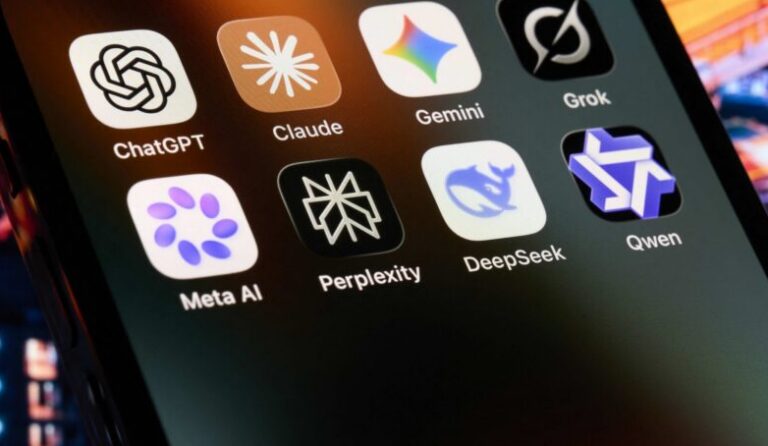
Chinese open-weight models, such as DeepSeek and Alibaba’s Qwen, offer a potential shortcut. They provide a cheaper, convenient technology that Indian developers can download and fine-tune for domestic needs. Since the Chinese model weights are openly available, Indian developers can run them on servers in India, keep data inside the country, and adapt the models with local datasets.
But using them also raises concerns over data security, political censorship, and the values built into foreign-made AI systems. Indian policymakers, including IT Minister Ashwini Vaishnaw, have acknowledged China’s role in the AI race while arguing that Chinese open-weight models could be deployed on Indian servers after appropriate security checks. The distinction points to an emerging strategy: borrow the technology, but retain control over the infrastructure and data.
The contrast is significant. On one hand, India is cautious about the DeepSeek app and the security implications of processing data outside India. On the other hand, India remains interested in using the underlying technology because of China’s open, downloadable, and modifiable AI offering, albeit under Indian control.
Other senior figures have placed AI as part of wider geopolitical competition. External Affairs Minister S. Jaishankar has spoken about the United States-China rivalry, while Prime Minister Narendra Modi has called for India to become a leading AI power based on sovereignty and inclusion. The objective is not simply to choose between U.S. and Chinese technology, but to build its own alternative.
“I see India’s approach as a deliberate “third path” between the U.S. and China: one built on public digital infrastructure and multilingual models rather than either raw compute scale or state-directed surveillance AI,” Raj Kapoor, chairman of India AI Alliance, told CGSP.
Linguistics is a major part of the challenge
Chinese open-weight models can, in principle, be repurposed for Indian languages. Their openness lets developers access the underlying model and modify it with additional language data. However, India presents a different challenge: an official linguistic landscape spanning 22 constitutionally recognized languages and many more regional varieties and dialects. Developing AI models that work reliably across this assortment requires not only more language data, but also a deeper understanding of local context and culture.
“Alibaba’s Qwen is genuinely best-in-class at multilingual and Asian-language tasks…On instruction-following [tests] across 14 Indic languages, Qwen actually outperforms Meta’s Llama in Indian languages like Bengali and Gujarati—so it’s not the worst performer, just not purpose-built the way an India-first model is,” Kapoor said.
Qwen’s multilingual capabilities, particularly across Asian languages, have made it competitive with leading Western models. In November 2025, Singapore expanded its regional language model project, SEA-LION, to incorporate Alibaba’s Qwen architecture.
“Labs invest deeply in the languages tied to their commercial and geopolitical footprint. China invests in Chinese and pan-Asian/BRI-partner languages; Western labs invest in English and major European languages. Nobody outside India has a strong commercial reason to solve India’s 22-language, 1,600-dialect problem as thoroughly as an India-first company would,” Kapoor pointed out.
Tests of DeepSeek V3.2, MiniMax 2.7, Llama 3.3, and Qwen3 in Indian languages have found an average 9-percentage-point performance gap between Indic-language and English-language versions of a task. That points to a real disadvantage, but that does not mean that Chinese models are fundamentally incapable of working with Indic languages. In fact, better data and targeted fine-tuning could narrow the disparity.
The second issue is model behavior. Language adaptation does not necessarily remove the political assumptions or restrictions embedded in a foundation model. Researchers have highlighted political biases in Chinese AI models, including one 2025 study showing that DeepSeek-R1 refused as many as 85 percent of politically sensitive questions related to China and can reflect Chinese government positions when discussing topics such as human rights and foreign policy. These restrictions are built into the model’s behavior and are unlikely to be removed simply by fine-tuning it for Indian languages, such as Tamil.
Three concerns: language performance, censorship, and data control
India’s reservations about foreign AI systems are not based solely on how accurately they answer questions in Indian languages. Security and confidentiality also play a major role. For example, India’s finance ministry restricted the use of DeepSeek and ChatGPT on government devices because of concerns about sensitive information and data security. That makes the debate fundamentally about sovereignty and control over information flows, rather than simply about model quality.
This changes the rationale behind India’s interest in developing domestic AI models. “So India’s parallel effort isn’t a bet that Chinese models can’t learn Indian languages—it’s a bet that owning the training data, alignment choices, and compute matters more than borrowing someone else’s (even excellent) foundation,” Kapoor stated.
India’s Sarvam AI’s positioning captures this idea, presenting its technology as AI infrastructure built specifically for India and under Indian control. The selling point is therefore as much about technological sovereignty as linguistic performance. This means that India’s push to develop its own large language models is not only about building domestic AI capabilities. It is increasingly tied to a broader strategy of technological sovereignty and geopolitical influence.
Among Indian policymakers, IT minister Ashwini Vaishnaw has been one of the clearest voices acknowledging China as part of the AI competition India must tackle. He has framed India’s planned foundation models alongside systems such as DeepSeek and ChatGPT, outlining the ambition to promote Indian developers in a race already dominated by Chinese and American firms.
Rajeev Chandrasekhar, the former IT minister and a prominent voice on technology policy, raised the possibility that DeepSeek could become the “TikTok of AI,” invoking the precedent of India’s 2020 restrictions on Chinese apps and the concerns surrounding data and national security. The concerns have also reached Parliament and the courts. Some Indian lawmakers have called for stronger action against DeepSeek, including an outright ban, while a petition seeking similar intervention was filed in the Delhi High Court. The court, however, said that privacy concerns are not limited to DeepSeek or Chinese AI models, but apply to AI platforms more broadly.
Use the model, keep control at home
Rather than trying to replicate the enormous computing scale of the United States or China’s state-backed technology ecosystem, Indian companies could compete by developing cheaper, more accessible systems with a practical combination of available technology.
Krutrim, an Indian AI and cloud computing company led by Bhavish Aggarwal, offered perhaps the clearest demonstration of this pragmatism. Soon after DeepSeek’s meteoric rise, Krutrim deployed DeepSeek–R1 on Nvidia H100 infrastructure located in India and made access available to developers at a low price. The move captured an emerging distinction in India’s AI strategy: caution about sending sensitive data to a foreign-hosted Chinese service, but willingness to use openly available Chinese model weights when they can be operated on infrastructure within India’s jurisdiction.
This may be the central contradiction—or perhaps the central logic—of India’s response to Chinese AI. New Delhi and Indian companies appear increasingly willing to separate the model from the service, and the technology from the infrastructure through which it is delivered.
So on paper, broad India-China relations may be improving, but concerns over AI and data security have not eased at the same pace. For New Delhi, the challenge is no longer simply whether Chinese AI can work in India, but whether it can be used without surrendering data control that underpins India’s AI ambitions.
Pradipta Mukherjee is a journalist based in Kolkata, India
Bottom Line
India’s AI choices could offer lessons for countries balancing U.S.-China technology competition, local language needs, and cost. Chinese models can help build domestic capabilities, but Indian policymakers and firms remain concerned about retaining control over data and avoiding overreliance on foreign technology.