

Top Line
It is commonly argued that Vietnam buys U.S. arms to balance against China. A closer look at the pace and contents of Hanoi’s arms purchases reveals a more nuanced balancing act.
In this edition of M&M, I want to discuss the political significance of the U.S. arms sales to Vietnam. Since U.S. President Barack Obama fully lifted the lethal arms embargo against Vietnam in 2016, there has been much speculation about what kind of U.S. weapons Vietnam will buy. Even more important than the weapons themselves is what kind of signal Vietnam sends to China with the arms sales.
What is the Misperception?
It is commonly argued that Vietnam buys, or will buy, U.S. arms to balance against China. Because Vietnam can neither ally with one country against another nor host foreign bases under its Four Nos, arms sales are one of the viable options that it can use to enlist foreign assistance. Vietnam understands that Russia sells arms to both Vietnam and China, and Vietnam cannot arms race with China on a piece-by-piece basis.
Buying U.S. arms gives Vietnam a qualitative edge. As the Russia-Ukraine War shows, a small power can combine Western technology with Soviet-era weapons to defend against a great power. In terms of signaling, buying U.S. arms suggests Vietnam expects its relationship with the United States to remain amicable for years to come, since it depends more on U.S. spare parts and maintenance expertise.
Why Do People Believe It?
Two factors help explain why this argument has gained traction: the timing of major developments in U.S.-Vietnam relations and public perceptions of bilateral exchanges. Looking back at the relationship since 2011, a recurring pattern emerges: improvements in U.S.-Vietnam ties often follow major disagreements between Vietnam and China.
The pattern began in 2011, when China cut the seismic exploration cables of a Vietnamese research vessel operating within Vietnam’s exclusive economic zone, triggering nationwide protests. The following year, U.S. Defense Secretary Leon Panetta visited Cam Ranh Bay, becoming the first U.S. defense secretary to do so since 1975. In 2013, Washington and Hanoi upgraded their relationship to a Comprehensive Partnership.
Tensions between Vietnam and China flared again in May 2014, when Beijing moved the Haiyang Shiyou 981 oil rig into Vietnamese waters, sparking massive protests across Vietnam. Five months later, the United States partially lifted its arms embargo on Vietnam. The relationship continued to advance in 2015, when Nguyen Phu Trong became the first general secretary of the Communist Party of Vietnam to visit the White House. A year later, Washington fully lifted the arms embargo.
A similar sequence unfolded in 2017, when China was reported by the BBC to have threatened attacks on Vietnamese bases in the Spratly Islands unless Hanoi halted energy exploration activities with a foreign oil company. In 2018, Vietnam welcomed its first visit by a U.S. aircraft carrier since 1975.
The pattern continued in subsequent years. In 2019, China and Vietnam engaged in a months-long standoff over Vanguard Bank. The following year, another U.S. aircraft carrier visited Vietnam. In 2021, Vice President Kamala Harris traveled to Hanoi and proposed upgrading bilateral ties to a Strategic Partnership. That process culminated in 2023, when the two countries elevated their relationship to a Comprehensive Strategic Partnership.
Taken together, these developments have reinforced the widespread perception that Vietnam is drawing closer to the United States to balance China. From that perspective, it is reasonable to assume that Hanoi would also seek to purchase U.S. weapons as part of the same strategy.
What Does the Evidence Show?
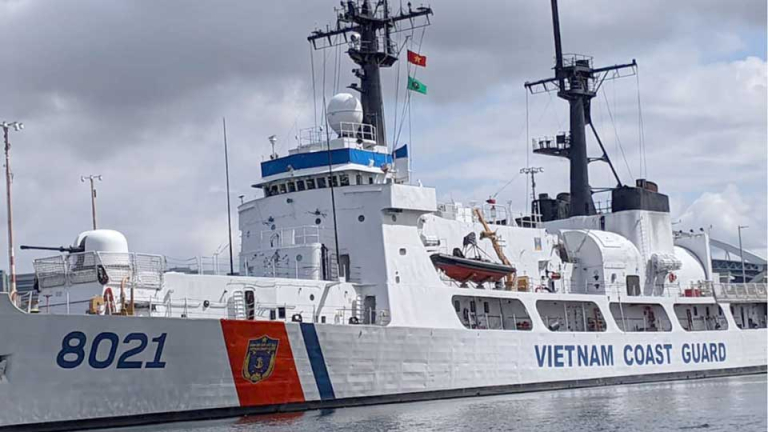
However, the actual amount of U.S. arms Vietnam has bought or has shown interest in doesn’t match the hype. As of November, it has received three Hamilton-class cutters between 2017 and 2025, signed a contract to buy 13 Metal Shark Defiant-class patrol boats, and requested to buy components, spare parts, and training aids for the C-130 military transport aircraft.
There are also reports of Vietnam reaching a deal to buy up to 24 F-16 fighters in April 2025 and two Lockheed Martin S-92 helicopters in July 2025, but Vietnam has not confirmed the reports, and these deals have not materialized.
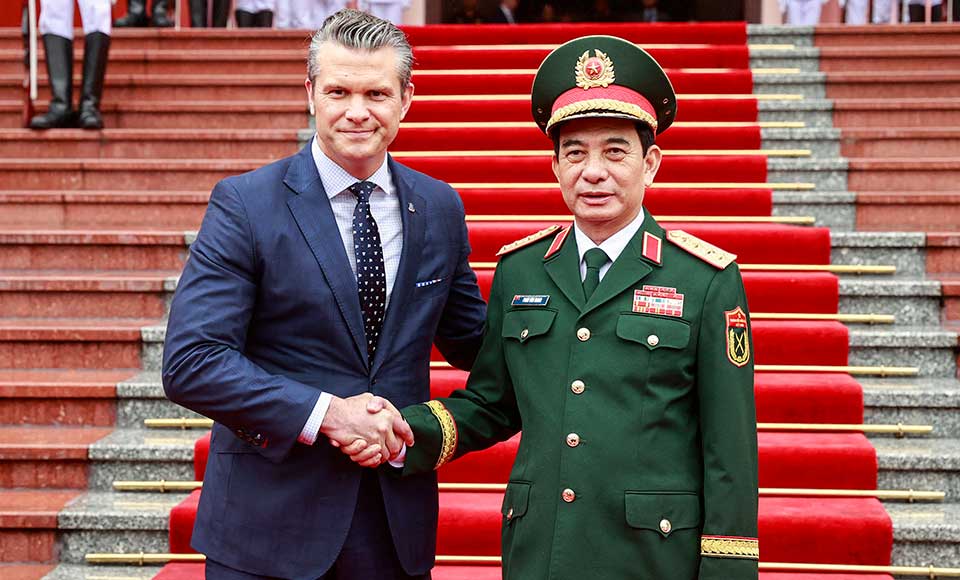
Even the weapons themselves are not militarily notable. The U.S. weapons Vietnam publicly confirmed interest in are either defensive, such as the C-130, or don’t significantly affect the balance of power with China, such as the Hamilton-class cutters or the Metal Shark patrol boats. Vietnam’s purchase of Russian arms, such as Kilo-class submarines, Gepard-class frigates, or Su-30 fighters, leaves a bigger impact on the military balance with China because they have offensive capability.
Vietnam has purchased so few U.S. arms that some watchers in Washington claimed the United States has “lost” Hanoi. If Vietnam wants to balance against China, it should have bought more U.S. arms to boost its asymmetric defense strategy like Ukraine has done.
However, the timing of these purchases or reports of Vietnam’s interest in U.S. arms is telling. Vietnam became more interested in U.S. arms after the Donald Trump administration targeted the country for the massive trade deficit in April 2025. Hanoi’s interest is likely not about balancing China but about correcting the trade deficit. Vietnam’s non-aligned foreign policy dictates when and what to buy from the United States.
Buying too much U.S. arms in a small window can raise China’s skepticism. Buying offensive weapons like Russian ones is a hard no. By contrast, buying nothing at all can make the United States question Vietnam’s allegiance and severely restrict Vietnam’s access to the U.S. arms market, which Vietnam still needs in a worst-case scenario.
The solution is to buy defensive weapons slowly to gauge both Beijing’s and Washington’s reactions. Phased-out purchases also let Hanoi test whether it can rely on U.S. spare-parts supply before committing to big-ticket items.
What Does This Mean?
Vietnam upgrading ties with the United States is not to join an anti-China coalition but to strengthen its own relations with China from a position of strength. Foreign observers should not interpret Vietnam’s U.S. arms purchases as balancing against China but as weapons diversification and modernization.
And if no arms deals are announced in the next few years, that should not be taken as a sign that Vietnam is no longer interested in the U.S. arms market.
Bottom Line
Vietnam’s purchases of U.S. arms are about more than balancing against China. Hanoi is diversifying its options while keeping Washington engaged and Beijing reassured.