

- Africa owns resources, but ownership alone is insufficient; states must ensure mining revenues fund public development not elite capture.
- Value addition is a means not an end; it must connect to industrial strategy and improved governance or it just enriches elites.
- Botswana and Debswana show that smart contracts and revenue management deliver development; contracts matter more than who officially owns mines.
African ownership of the continent’s vast mineral wealth took center stage during an October meeting in Beijing between Chinese President Xi Jinping and his Botswana counterpart Duma Boko. It was Boko’s declaration that “Africa’s natural resources belong to Africa” that grabbed the headlines, underscoring what he described as a fundamental principle for any cooperation in the continent’s mining industry.
It was neither surprising nor accidental that minerals were central to Xi and Boko’s meeting. Since China’s MMG took over the Khoemacau copper mine in 2024, Botswana has increased its copper supply to China. Chinese customs data show that by August 2026, bilateral trade had already matched the $1.2 billion recorded for all of 2025. Of the $1.1 billion China imported from Botswana, $1.09 billion was copper concentrate.
During the meeting, Xi put forward a four-point proposition on mining cooperation built around that principle. He called Africa’s position at the bottom of global value chains a historical injustice and offered Chinese help with value addition, technology transfer, mining development planning, and new financing models.
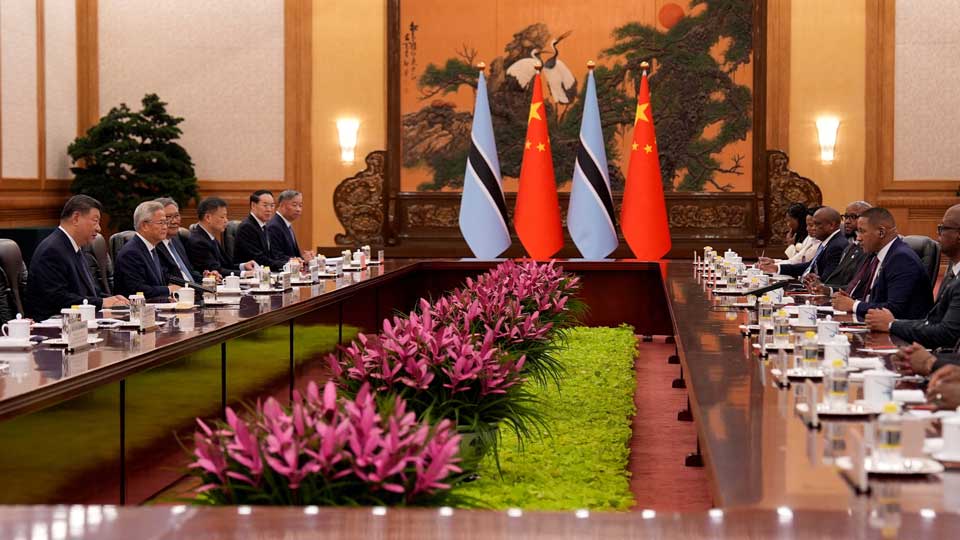
Xi’s comment on Africa’s mineral ownership drew some criticism online, where one reader on X replied: “Talk is cheap. Check the contracts, not the speeches.”
This kind of charged statement is understandable. It makes sense for African countries to take pride in owning and controlling mining operations on their own lands. But the debate over mining ownership often gets caught up in who owns what, rather than the crux of the issue: how producing countries capture and manage mining revenues.
What do we actually mean by “owning”? What matters more: that a Congolese or South African flag flies over the mine? Or that the mine’s revenue pays for the country’s development?
Those are two very different demands. It seems like a lot of energy goes into the first one, assuming mine ownership equals more revenue or better revenue management, which isn’t always the case.
Mine Ownership Doesn’t Guarantee Development Revenue
Whoever operates a mine pays taxes, royalties, and dividends to state partners. That money returns to national coffers. The honest question is what happens to it next.
Too often, the answer is uncomfortable. It does not build roads or power lines. It does not seed new industries. It does not prepare an economy for the day mining is no longer central. Because citizens never see where the revenue goes, they conclude the mining company took everything.
Foreign miners are not charities. They make money, and they expect returns for investing in risky environments. We can debate the imbalance of the mining agreements they sign with governments, but we cannot pretend that no revenue reaches the state. The leak is very often on our side of the ledger.
Value Addition Is Not an End in Itself
The same problem runs through the value-addition debate. Across the continent, the case for local processing is almost always fiscal. Refine the copper further, export it at a higher price, collect more revenue. That is where the argument usually ends.
African governments rarely frame value addition in industrial terms. Few say we want cathodes because they feed a cable industry, create jobs, and build skills. Without that link, a refinery is just a more expensive way to export a raw material.
If governance doesn’t change, more value addition simply means more money for elites. More revenue to embezzle is not development. Value addition is a means. We keep treating it as the goal.
Botswana Shows Why Contracts Matter More Than Flags
Botswana, the country Xi was speaking to, proves the point. For decades, De Beers and Botswana, through their 50-50% joint venture Debswana, mined the country’s diamonds, managed revenues, and spent them on schools, roads, and reserves. Its flag was not on the company. Its interests were in the contract.
It is also why Botswana is turning to copper, and to China. Diamonds are in decline. The country is diversifying, using a new resource and a new partner, while also restructuring its agreement with De Beers to retain more value addition and expertise.
None of this erases history. Africa’s extractive economies were built to keep the continent at the bottom of the value chain, first by Western powers and then by a system China stepped into. History explains the problem, but it does not excuse how we manage the money today.
So Xi’s line is not flowery rhetoric. It is true. But it must be read correctly. It is not a promise that China will hand over the value chain, current export controls on various minerals processing technologies say a lot. It reminds each African government to decide what it wants from its resources, rather than using them as a bargaining chip in someone else’s rivalry.
Africa’s resources belong to Africa. So does the responsibility for what they pay for.
C. Geraud Neema is CGSP’s Africa Editor.